House of
the Rising
Sun
The most recorded folk song in history. Nobody knows who wrote it. Nobody knows if the house ever existed. And yet, for over a century, it has ruined — and saved — countless lives.
There is a house in New Orleans. Or there was. Or there never was at all. That ambiguity — that gorgeous, maddening uncertainty — is precisely what has made "House of the Rising Sun" the most enduring mystery in American folk music. The song has been recorded over 500 times. It has been sung by a 16-year-old Kentucky miner's daughter, a blind Texas bluesman, a Newcastle rock band in a single take, and a country music legend. Nobody agrees on what the Rising Sun was. Nobody agrees on who wrote the song. And nobody — not Alan Lomax, not Ted Anthony, not any of the dozens of researchers who have spent careers chasing it — has ever found the building.
What we do know is this: the song is old. Older than The Animals' 1964 recording that made it famous. Older than Lead Belly's 1944 version. Older, perhaps, than America itself. Its roots reach back through Appalachian hollows, across the Atlantic to English bawdy house ballads, and possibly all the way to 17th-century broadside songs sold on the streets of London. It is a song about ruin — and it has refused to be ruined.
"There is a house in New Orleans, they call the Rising Sun. It's been the ruin of many poor girl, and me, oh God, for one."
The English Root
Folklorist Alan Lomax traced a possible ancestor to English bawdy house songs — a Norfolk farm labourer named Harry Cox knew a song about a 'Rising Sun' brothel in Lowestoft, England's most easterly town. The melody may have crossed the Atlantic with early settlers, mutating as it moved through Appalachian hollows.
Miners Know It
The song is said to have been known among American coal miners as early as 1905 — passed mouth to ear, verse to verse, across the mountain communities of Kentucky, Tennessee, and West Virginia. No recording exists. Only the memory of men who sang it underground.
First in Print
Robert Winslow Gordon publishes the earliest known written lyrics in Adventure magazine, under the column 'Old Songs That Men Have Sung'. The version is sung from a woman's perspective — a warning to others about the house that ruined her.
First Recording
Clarence 'Tom' Ashley and Gwen Foster record 'Rising Sun Blues' on September 6 for the Vocalion label. Ashley says he learned it from his grandfather Enoch Ashley, who married around the time of the Civil War — pushing the song's origins back to at least the 1860s.
Georgia Turner & Alan Lomax
Folklorist Alan Lomax sets up his recording equipment in Middlesboro, Kentucky, in the house of activist Tillman Cadle. There he records Georgia Turner, the 16-year-old daughter of a local miner, singing 'The Rising Sun Blues'. Her version — female narrator, haunting and raw — becomes the most cited early recording. Lomax credits her in his 1941 songbook Our Singing Country.
The Folk Era
Woody Guthrie records a version in 1941. Josh White records it for Keynote Records in 1942. Lead Belly records two versions — 'In New Orleans' (1944) and 'The House of the Rising Sun' (1948). The song spreads through the folk revival circuit, carried by medicine shows, railroads, and the new world of radio.
The Animals — One Take
On May 18, 1964, The Animals record 'House of the Rising Sun' in a single take at a London studio. Eric Burdon's raw vocal, Alan Price's haunting organ, and Hilton Valentine's now-iconic A-minor arpeggio transform a centuries-old folk lament into the first folk rock hit. It reaches #1 in the UK and USA. The world finally knows the song — but almost nobody knows its name.
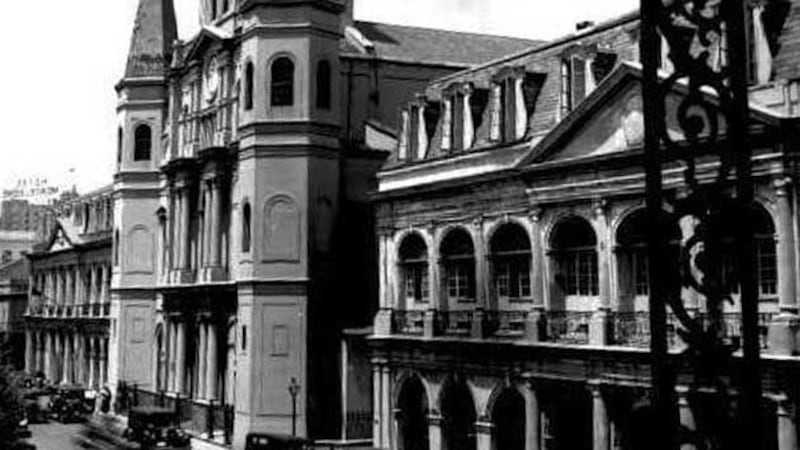
New Orleans, 1930s. The city that gave the song its name. But did it give it its story?
Researchers, historians, and obsessives have spent decades trying to identify the actual building. Four main theories have emerged — and none has been definitively proven.
The Brothel Theory
The most popular theory: the Rising Sun was a real New Orleans brothel, possibly on St. Louis Street or Conti Street in the French Quarter. Several establishments used the name. One, reportedly run by a madam named Marianne LeSoleil Levant ('the rising sun' in French), has been cited — though no definitive historical record confirms it.
The Gambling House Theory
Some researchers argue the 'house' was a gambling den, not a brothel. The male narrator versions of the song ('many poor boys to destruction has gone') fit a gambling house more naturally. New Orleans had dozens of notorious gambling establishments in the 19th century, several of which used sun imagery.
The Women's Prison Theory
A third theory points to the Orleans Parish Women's Prison, whose entrance gate was adorned with a rising sun motif. In this reading, the song is about incarceration — the 'ruin' is imprisonment, not vice. The prison stood in New Orleans for decades and was notorious for its conditions.
The English Origin Theory
Alan Lomax himself believed the song's roots were English — a bawdy house ballad from East Anglia that crossed the Atlantic with Scots-Irish settlers and was re-rooted in Appalachian soil. The 'Rising Sun' would then be a transplanted English pub name, relocated to New Orleans by storytellers who needed a more dramatic setting.
The Animals, May 18, 1964
The session lasted fifteen minutes. The Animals — a five-piece R&B band from Newcastle — had been playing the song live for months, having heard it through Bob Dylan's 1962 folk recording. They walked into a London studio, set up, and recorded it in a single take. No overdubs. No second chances. Just Eric Burdon's raw, aching vocal, Alan Price's churning organ, and Hilton Valentine's A-minor guitar arpeggio that would become one of the most recognisable openings in rock history.
The song was released in June 1964. It reached number one in both the UK and the United States. It was the first time a rock rhythm had been applied to a folk song — making it, by most accounts, the first folk rock hit ever recorded. The Animals received no songwriting credit and no royalties. The song was listed as "traditional, arranged by Alan Price" — a decision that would cause bitter disputes within the band for decades.
But the song's power was undeniable. It ran for four minutes and thirty seconds — at the time, almost unheard of for a pop single. Radio stations played it anyway. Listeners who had never heard of Georgia Turner or Clarence Ashley or Alan Lomax heard, for the first time, a song that had been travelling for a hundred years to reach them.
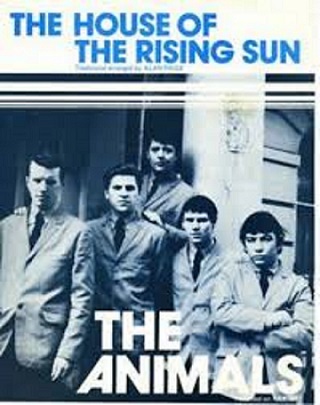
The Animals · 1964 Single
The mystery of the Rising Sun is, in many ways, the mystery of folk music itself. Songs like this one were never meant to be owned. They were meant to be borrowed, altered, passed on — each singer adding their own verse, changing the gender of the narrator, relocating the house to suit their own geography of loss. The song survived because it was never fixed. It was always becoming.
Ted Anthony, who spent years chasing the song across twelve states and the Atlantic Ocean for his book Chasing the Rising Sun, concluded that the song's power lies precisely in its anonymity. "It belongs to everyone," he wrote, "because it belongs to no one." The house may never have existed. The ruin it describes is universal.
Today, the song is still being recorded. Still being argued over. Still being sung in bars in New Orleans by tourists who don't know its history, and by blues musicians who know every version ever cut. Somewhere in the French Quarter, there may or may not be a building with a rising sun above its door. It doesn't matter. The house lives in the song. And the song lives in everyone who has ever felt, even briefly, that they were going wrong.
"It belongs to everyone, because it belongs to no one."